
Answer the decision, not just the diagnosis
An original teaching case: a dog presents after repeated vomiting. The dog is dull, has weak peripheral pulses and a prolonged capillary refill time, and cannot stand comfortably. Abdominal imaging may eventually help identify the cause. But what must the team address before a prolonged diagnostic workup?
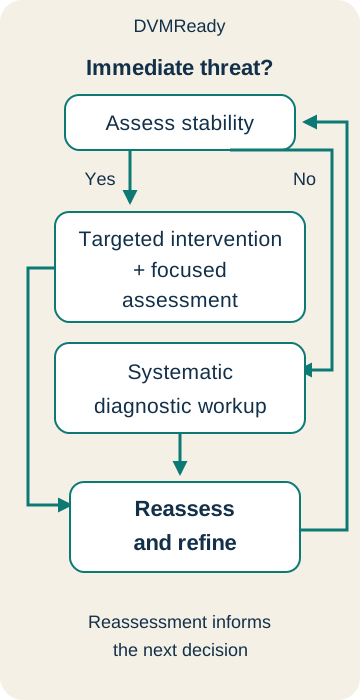
The key distinction is between identifying the disease and identifying an immediate threat. In an unstable patient, the next useful action may protect life while the cause is still uncertain.
The NAVLE assesses knowledge relevant to entry-level clinical practice, rather than a list of diagnoses alone. This article offers a study framework, not an official ICVA answering rule or recalled examination question. ICVA preparation guidance
1. Make a rapid stability assessment
A primary survey asks whether an immediately dangerous problem is present. Assess airway patency, breathing, perfusion and mental status. In trauma, the XABCDE approach explicitly prioritizes catastrophic hemorrhage, then airway, breathing, circulation, disability and exposure/environment.
Interpret findings together. Weak pulses, abnormal mentation, mucous membrane changes and an abnormal capillary refill time matter more as a pattern than as isolated vocabulary clues. A heart rate alone does not establish or exclude shock.
In the teaching case, compromised perfusion requires attention; “vomiting” should not narrow the response prematurely to gastrointestinal diagnostics. This does not establish the exact mechanism of shock. Merck: primary survey
2. Stabilization is targeted, not a reflex prescription
Resuscitation, rehydration and maintenance are different fluid-therapy goals. For hypovolemia, rapid intravascular support requires intravenous or intraosseous access; correcting an interstitial water deficit is not the same task.
However, “unstable” does not automatically mean “give the same fluid bolus.” Patient assessment, suspected mechanism, comorbidities and response determine the prescription. Excess fluids can cause harm. Reassess perfusion after intervention and revise the plan rather than repeating a memorized volume without checking the patient. 2024 AAHA fluid-therapy guidelines
3. Do not turn “stabilize first” into “diagnose nothing”
Rapid assessment and focused diagnostics can guide immediate treatment. What should wait is a test whose handling, positioning or delay creates more risk than its immediate information provides.
Consider a second teaching scenario: a cat arrives with marked respiratory effort. Oxygen support and low-stress assessment take priority over forcing a complete examination. Initial findings help categorize the breathing problem and guide urgent treatment. Definitive diagnostic work can follow as tolerated. Basic stabilization also matters before referral; transport is not treatment. Thomovsky and Ilie: Basic triage in dogs and cats, Part I
4. Return to localization and cause
After initial stabilization, a systematic secondary survey and a fuller history help identify the underlying disease and concurrent problems. Ask about onset, progression, medications, exposures and prior illness, then select tests that answer the remaining clinical questions.
Reassessment remains essential. Lactate, when appropriate, can contribute to monitoring alongside clinical findings; it is not a substitute for the whole patient. Improving one measurement does not finish the investigation. Merck: secondary survey
A useful question-review habit
For each next-step practice question, write three short lines:
- Threat: What finding makes delay unsafe, or what supports stability?
- Action: What does my selected option accomplish now?
- Recheck: What would change the next decision?
For the vomiting dog, simply writing “obstruction” skips the first decision. Simply writing “fluids” skips the indication, monitoring and search for the cause. A stronger answer explains the priority and preserves the subsequent diagnostic plan.
Takeaway: Recognize instability before pursuing complete localization, but do not separate resuscitation from useful clinical reasoning. Choose the next action for this patient at this moment.
Limitations
These simplified examples teach prioritization, not complete emergency protocols. The sources include expert clinical reviews and guidelines, not a trial validating this study method. Real care depends on examination, available resources, supervision and condition-specific treatment. No fixed drug or fluid-dose protocol is supplied, and no examination outcome is promised.
DVMReady provides independent educational support. Verify current examination, licensing, and clinical information with the relevant official source and professional references.
Official Sources
Check current guidance against the original sources.