
If your cat is breathing with an open mouth, visibly struggling to breathe or collapsing, seek emergency veterinary help now. Do not delay to finish counting breaths. Keep handling and stress to a minimum while arranging transport.
For a comfortable, sleeping cat, counting breaths can provide useful information for your vet. It is an observation, not a home test that proves the heart and lungs are healthy.
How do I count sleeping breaths?
Choose a time when your cat is asleep or resting quietly, not purring.
- Watch the chest or side of the body.
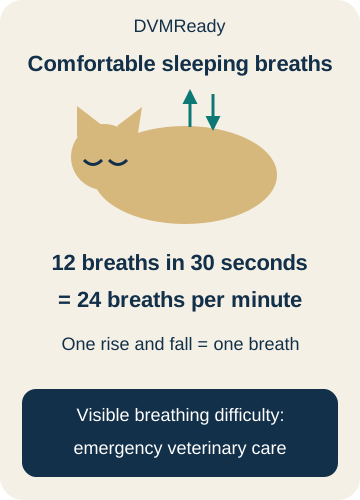
- Count one rise and fall as one breath.
- Count for 30 seconds, then multiply by two. Alternatively, count for a full minute.
- Record the result, time and whether your cat was asleep.
For example, 12 breaths in 30 seconds equals 24 breaths per minute. There is no need to wake or hold your cat to measure this.
What number should concern me?
A typical quiet resting or sleeping rate is approximately 15–30 breaths per minute. A rate consistently above 30, or an increase from your cat’s usual pattern, should be discussed promptly with your veterinarian. Cats being monitored for heart disease may have an individual threshold and action plan.
Activity, heat and stress affect breathing, so a measurement after play is not equivalent to a sleeping measurement.
Look at effort, not just the number
A cat working hard to breathe needs help even if you have not obtained a high count. Watch for pronounced chest or belly movement, noisy breathing, an open mouth, or collapse. Do not assume these signs are normal simply because your cat seems stressed.
Breathing difficulty has several possible causes, including asthma, heart failure and fluid around the lungs. These cannot be reliably distinguished from a breathing count or online description, and they require different treatments. Do not try to resolve breathing distress at home.
What should I tell the vet?
A concise description is more useful than saying only “breathing fast”:
“My cat was asleep, not purring. I counted 18 breaths in 30 seconds, which is 36 per minute. This is different from the usual pattern.”
Also mention when the change began, any known heart or lung condition, current medications, and other changes you have noticed. Do not postpone emergency travel to collect a longer record.
Bottom line: Counting comfortable sleeping breaths can help your veterinary team. Visible breathing difficulty always takes priority over the number.
General education for cat owners. This article cannot diagnose a breathing problem or replace urgent assessment or your cat’s individual monitoring plan.
Sources: VCA breathing-rate guide, PDSA breathing problems in cats, Cornell: difficulty breathing.
DVMReady provides independent educational support. Verify current examination, licensing, and clinical information with the relevant official source and professional references.
Official Sources
Check current guidance against the original sources.